
Why algae
Algae turn sunlight, CO₂ and water into proteins, oils and pigments — faster than any crop, without farmland, and while cleaning water.
Two worlds
Micro or macro?
Single-celled organisms, invisible to the eye, grown in photobioreactors or ponds. Fast-growing biochemical factories.
Examples
- Spirulina
- Chlorella
- Dunaliella
- Nannochloropsis
- Tetraselmis
Used for
Protein, phycocyanin, β-carotene, omega-3, hatchery feed
The case
Six reasons the future is green-blue.
Oxygen makers
Algae produce roughly three quarters of the oxygen we breathe.
Fast growers
They grow far faster than land crops and need much less space.
No farmland
Algae thrive on non-arable land, in seawater and even in wastewater.
Carbon & nutrient capture
They fix CO₂ and remove nitrogen and phosphorus — natural bioremediation.
Rich chemistry
Proteins, omega-3 oils, pigments and bioactives for food, health and beauty.
Ancient & proven
Among the oldest photosynthetic organisms on Earth — evolution's R&D lab.
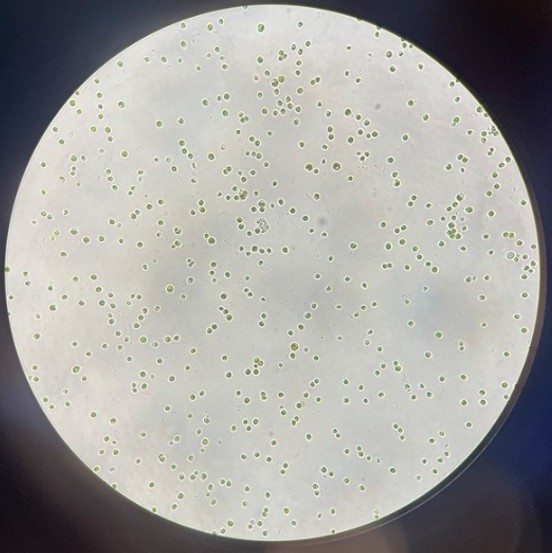
Under the microscope
Millions of cells in a single drop.
Each tiny green dot is a complete microalgal cell — a self-sufficient factory that turns light and CO₂ into proteins, oils and pigments. Getting the most from them starts with understanding them, one culture at a time.
How it's grown
Five ways to cultivate.
Each system trades cost, control and purity differently. Choosing the right one is often the most important decision in a project.
Scroll sideways →
9.7bn
People to feed by 2050. Most of Europe’s seaweed is still imported from Asia. Local, controlled algae production is one of the clearest ways to close that gap.
Have an algae question?
Tell us about your project. The first conversation is always free.